Design engineer, AI products · Tampa, Florida

Ryan Baltodano, smiling, in a dark suit and white shirt.
Ryan Baltodano

“This was a good day... Stepping into an unknown chapter, I always do my best to take the next right step.”

I design software and write the code that ships it, from the first Figma frame to the Rust underneath. Lately that’s two apps I built on my own: Angrove and inVectus.

By day I design client websites at PostcardMania. Next, I want to build software that’s interesting, useful, and beautiful, because if it isn’t beautiful, why bother? Happy to move to New York or San Francisco for it.

Exhibit I · Independent product

Angrove

Public betaon iPhone

A study harness for deep learning that happens to ship with a language model built in. Think Claude Code, but for education. I designed it in Figma and built it in SwiftUI, with the model and search running on your device.

Visit Angrove
Fig. 1

The project

I design and build Angrove around a continuing line of study: ask a question, follow its sources, explore a definition, and save an Insight to revisit on a map of related ideas. On-device AI and source retrieval keep inquiry private, with saved personal data encrypted on the device. On Mac, Boards bring conversations, notes, saved Insights, and images into one workspace.

Platform
iPhone & Mac
Built with
Swift, SwiftUI, Core ML, MiniLM, LiteRT-LM
My role
Independent creator: product design, application architecture, implementation, and testing
Status
iPhone public beta on TestFlight; native Mac app in development. Captures include development features.

How a study session works
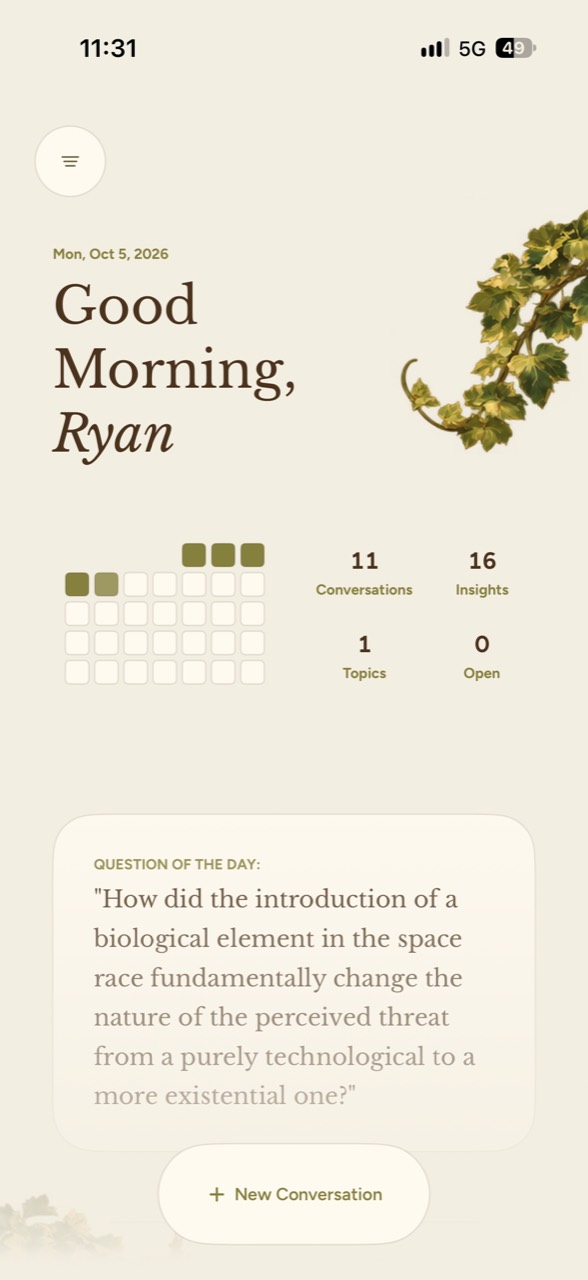
  1. Angrove Home with activity, saved Insights, and a Question of the Day.
    01Start from Home. Recent activity, saved Insights, and a Question of the Day.
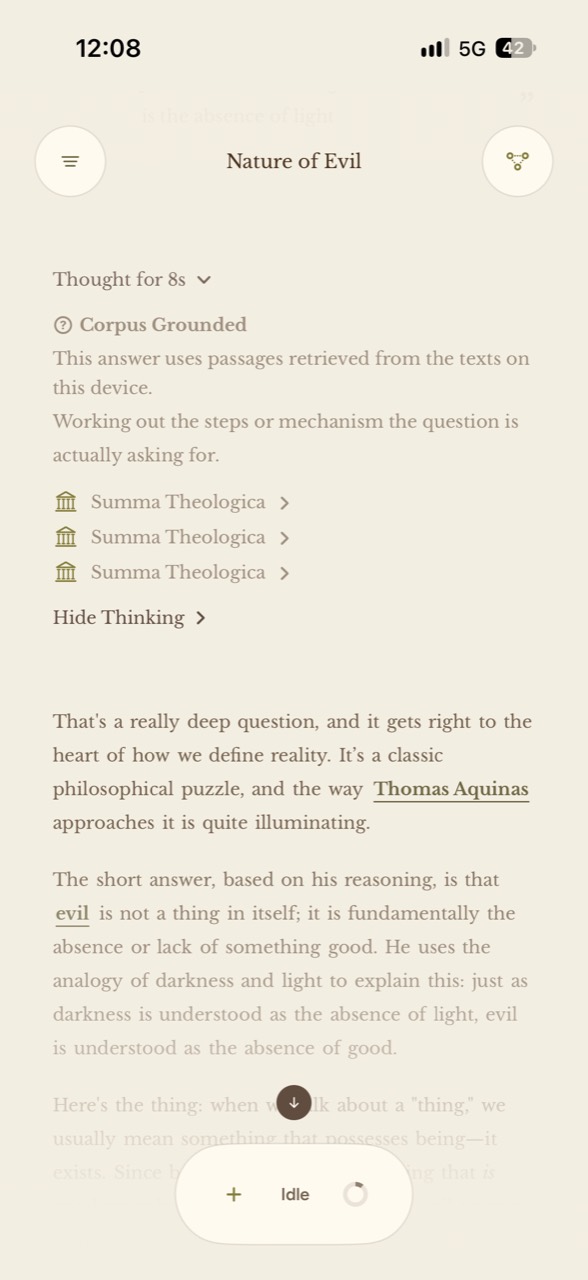
  2. Nature of Evil conversation with expanded Corpus Grounded details and Summa Theologica source links.
    02Ask with sources. Answers show the passages they draw on, such as the Summa Theologica.
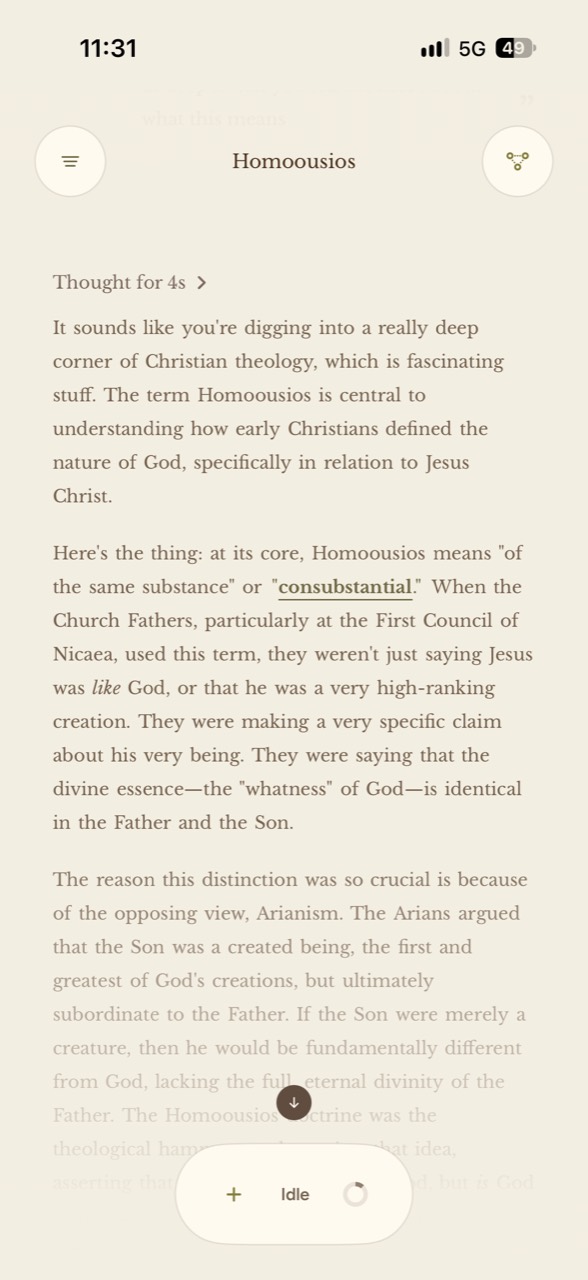
  3. Homoousios conversation with consubstantial highlighted as a contextual concept.
    03Open a concept. Underlined terms open a definition in the context of the answer.
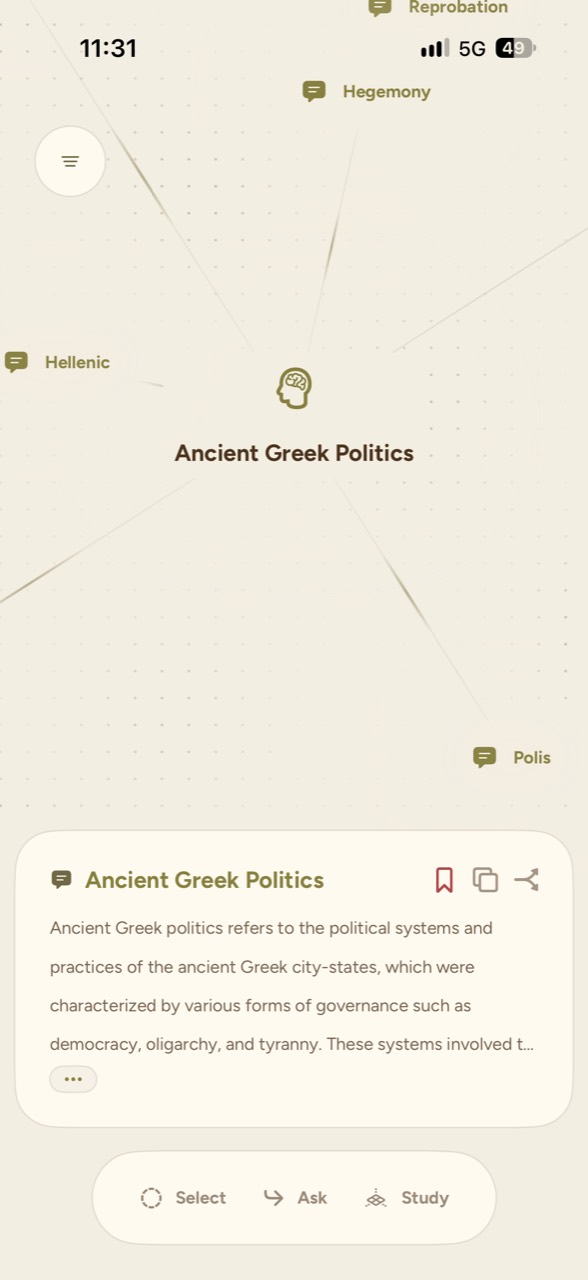
  4. Ancient Greek Politics map with related concepts and a saved Insight card.
    04Keep it. Saved Insights return on a map of related ideas.
Fig. 2

Room for a visual reference

An image shares the workspace with the writing. A Board can hold more than a sequence of chat messages, so an argument can take a shape on the page.

Design & engineering

From design to implementation

Shared SwiftUI features, design tokens, retrieval, and persistence serve both native apps; each platform owns navigation and input. Core ML MiniLM embeddings connect saved Insights on an interactive map. AES-256-GCM protects personal stores with Keychain-managed keys. Architecture and tradeoffs.

One runtime, many interactions

Answers, definitions, and tree updates share one LiteRT-LM runtime and a cancellable task queue. Stable conversation and branch IDs let answers finish after navigation without writing into another thread. Regression suites cover late results, retrieval, and storage migration. State and task ownership.

Test the default before choosing it

On two 40-case development sets, thinking on and off each totaled 74/80 objective passes. Simulator CPU median answer times rose from 23.0/23.5s to 43.7/47.6s with thinking, supporting the off default. These are pattern-scored configuration comparisons, not phone speed or general accuracy. Evaluation and limitations.

Exhibit II · Independent product

inVectus

v0.1.0on Mac

A negative search engine to find what doesn’t exist. Most search finds what’s already in your data. inVectus finds the gaps, then shows you the evidence so you can decide what’s worth chasing.

Visit inVectus
Fig. 3

The project

inVectus began when my older brother was looking for a medical-school research topic. My work on Angrove had taught me how embeddings connect concepts; I saw a way to apply that knowledge to patterns of coverage across papers. I turned the idea into a local-first workspace for exploring collections, inspecting evidence, and keeping research decisions.

Platform
Mac; Windows and Linux in beta
Built with
React, TypeScript, Tauri 2, Rust, DuckDB, LanceDB
My role
Independent creator: interaction design, frontend implementation, and shared Rust engine
Status
v0.1.0 released for macOS with a one-line installer, MIT licensed. Windows/Linux beta in testing.

Show the numbers behind a judgment.

Demand, coverage, and activity stay visible beside a flagged gap. The score is something to inspect, with the supporting papers close at hand.

A typical workflow

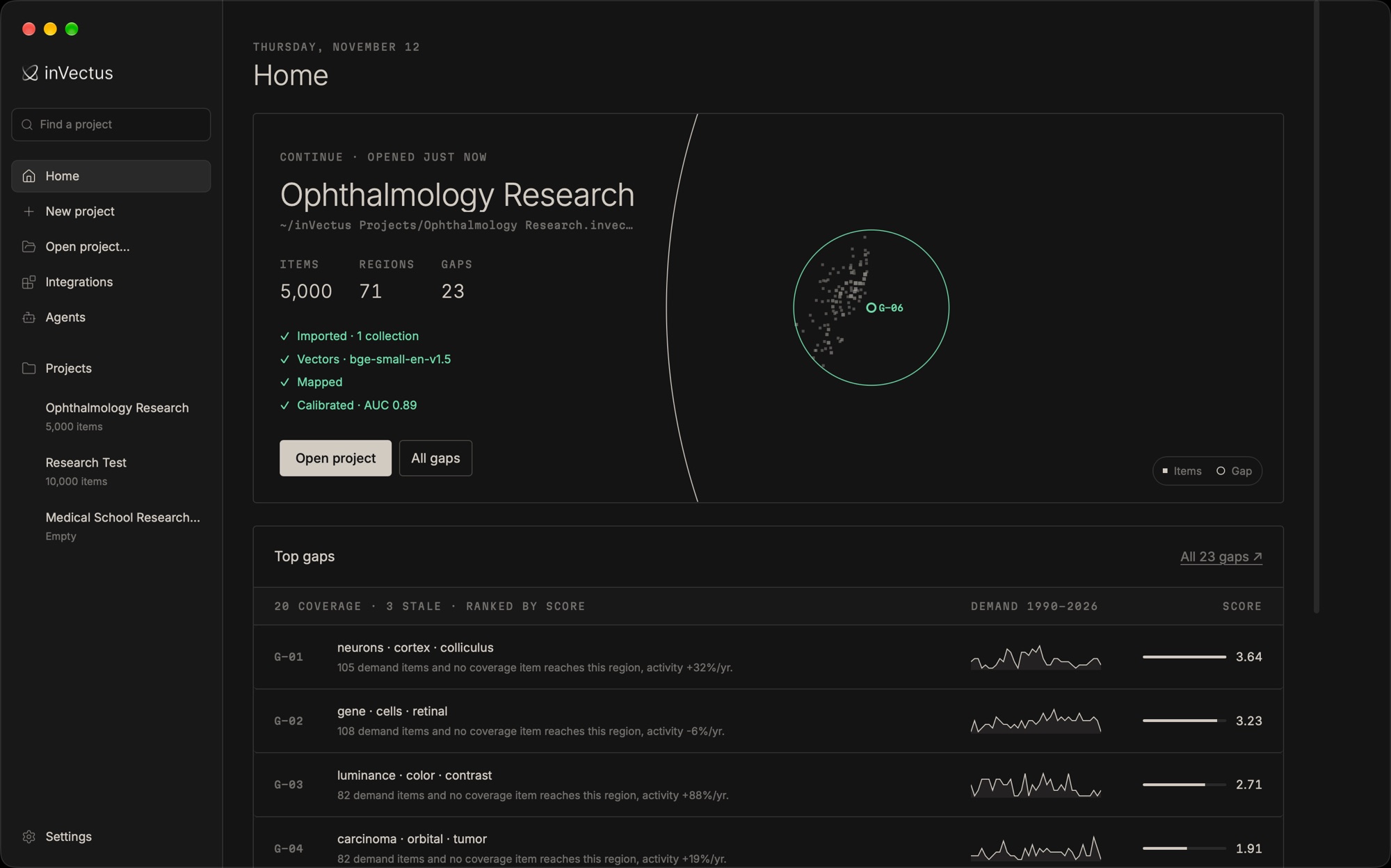
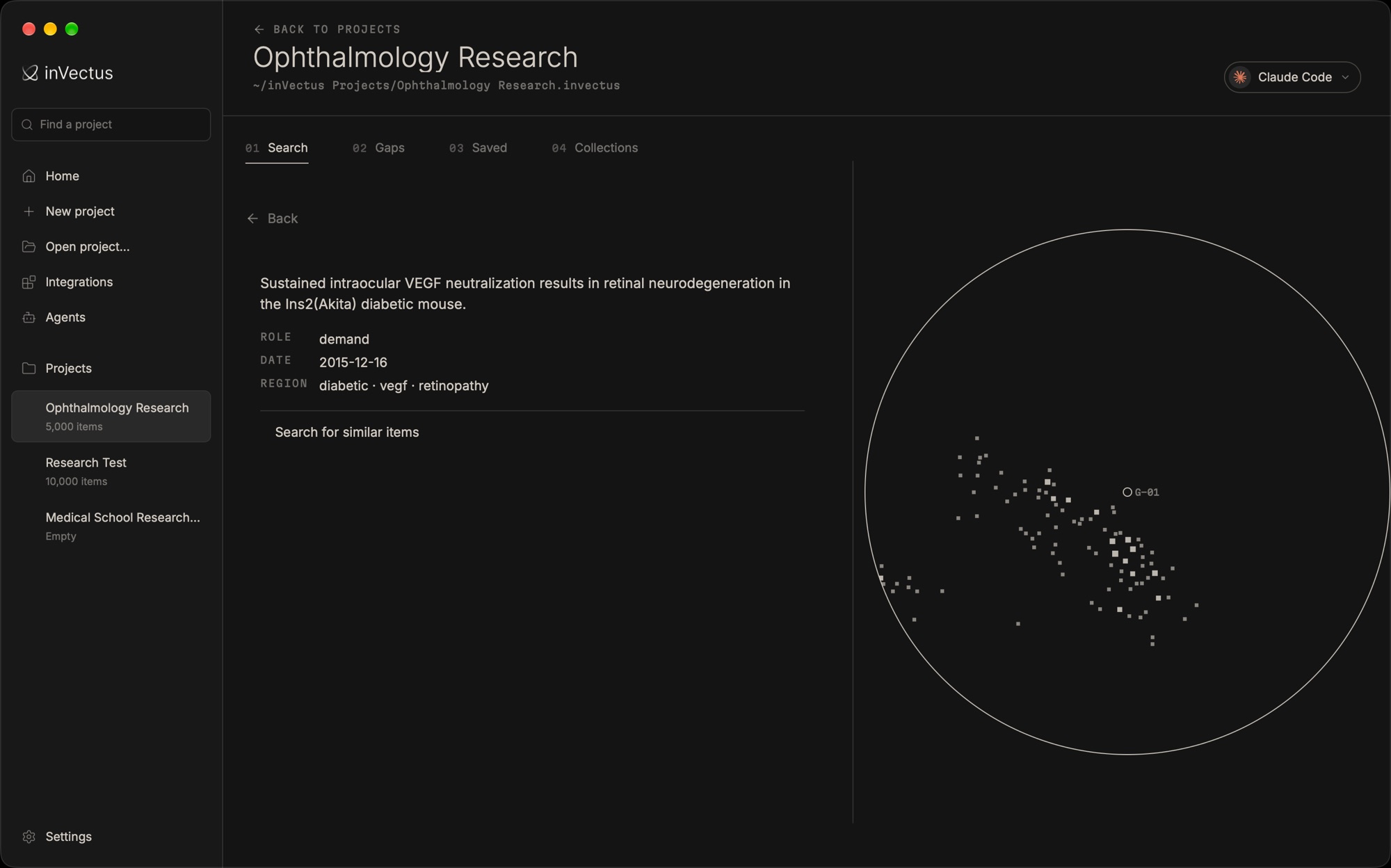
  1. inVectus Home with the open project’s readiness, map, and top-ranked gaps.
    01Start from Home. See whether the open project is ready, where its gaps sit, and which rank highest.
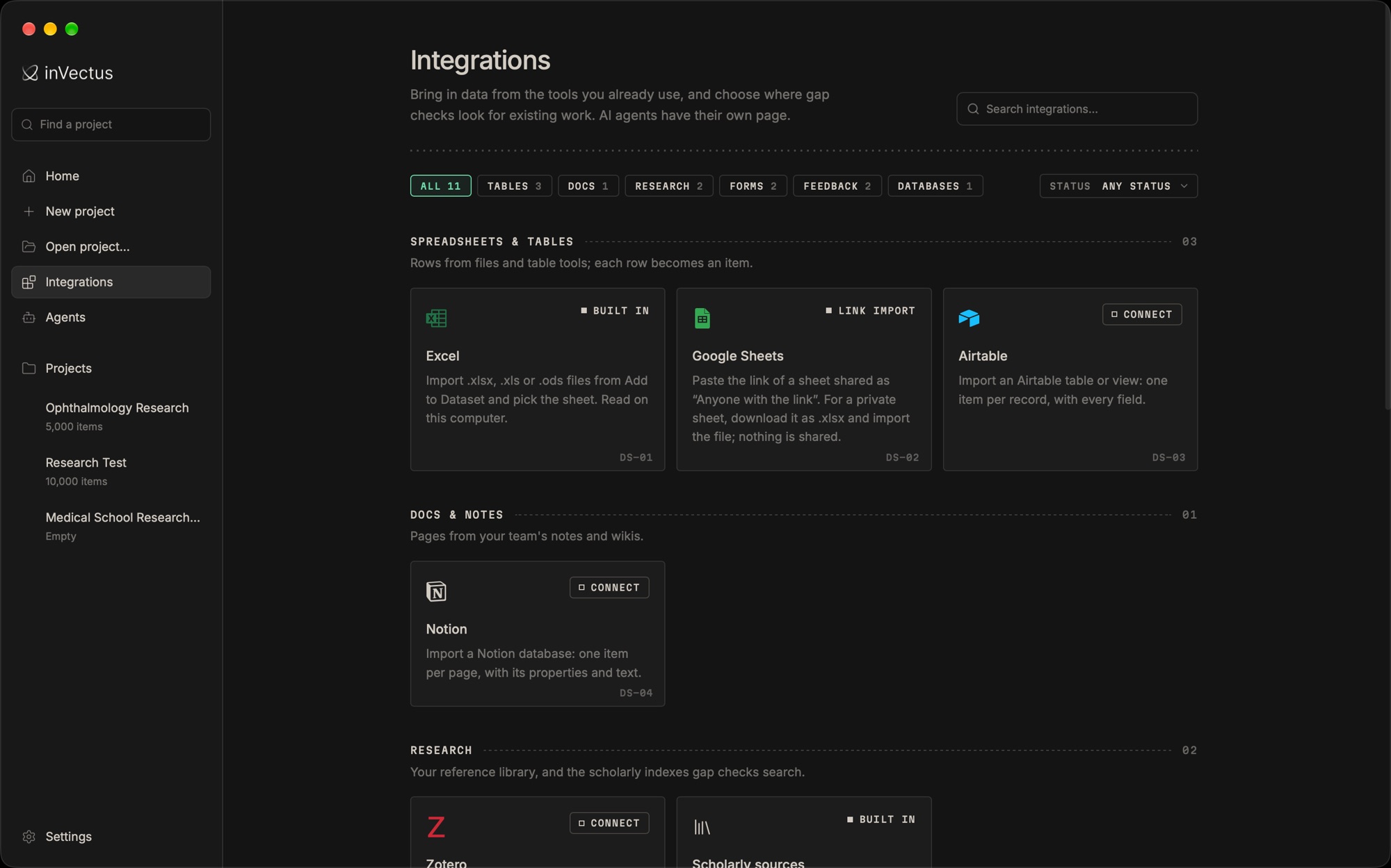
  2. Integrations for spreadsheets, notes, research libraries, forms, and databases.
    02Bring in data. Pull from spreadsheets, notes, reference libraries, forms, and databases.
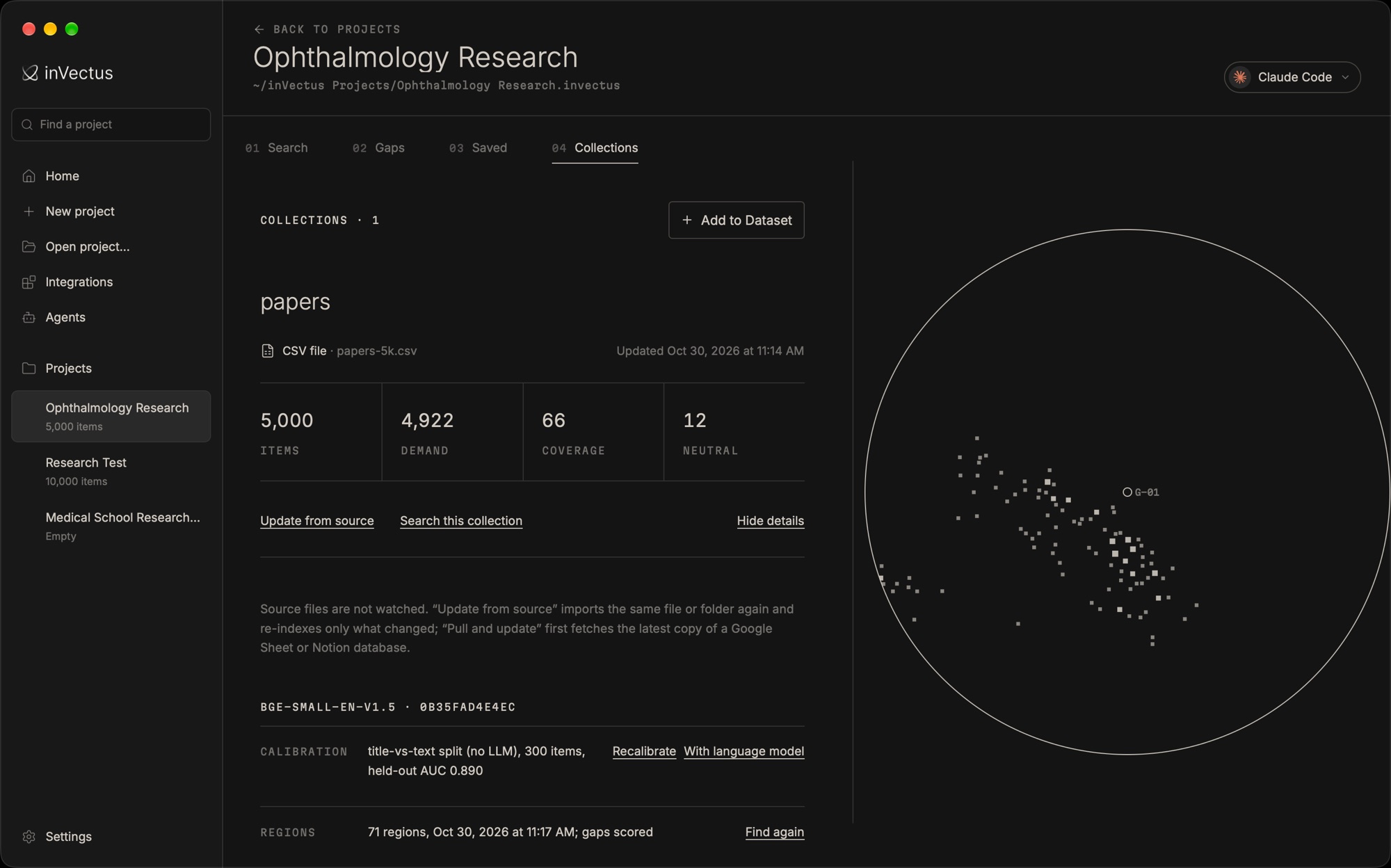
  3. The indexed medical collection, with role counts and calibration details.
    03Import a collection. Check that it’s indexed, with role counts and calibration details.
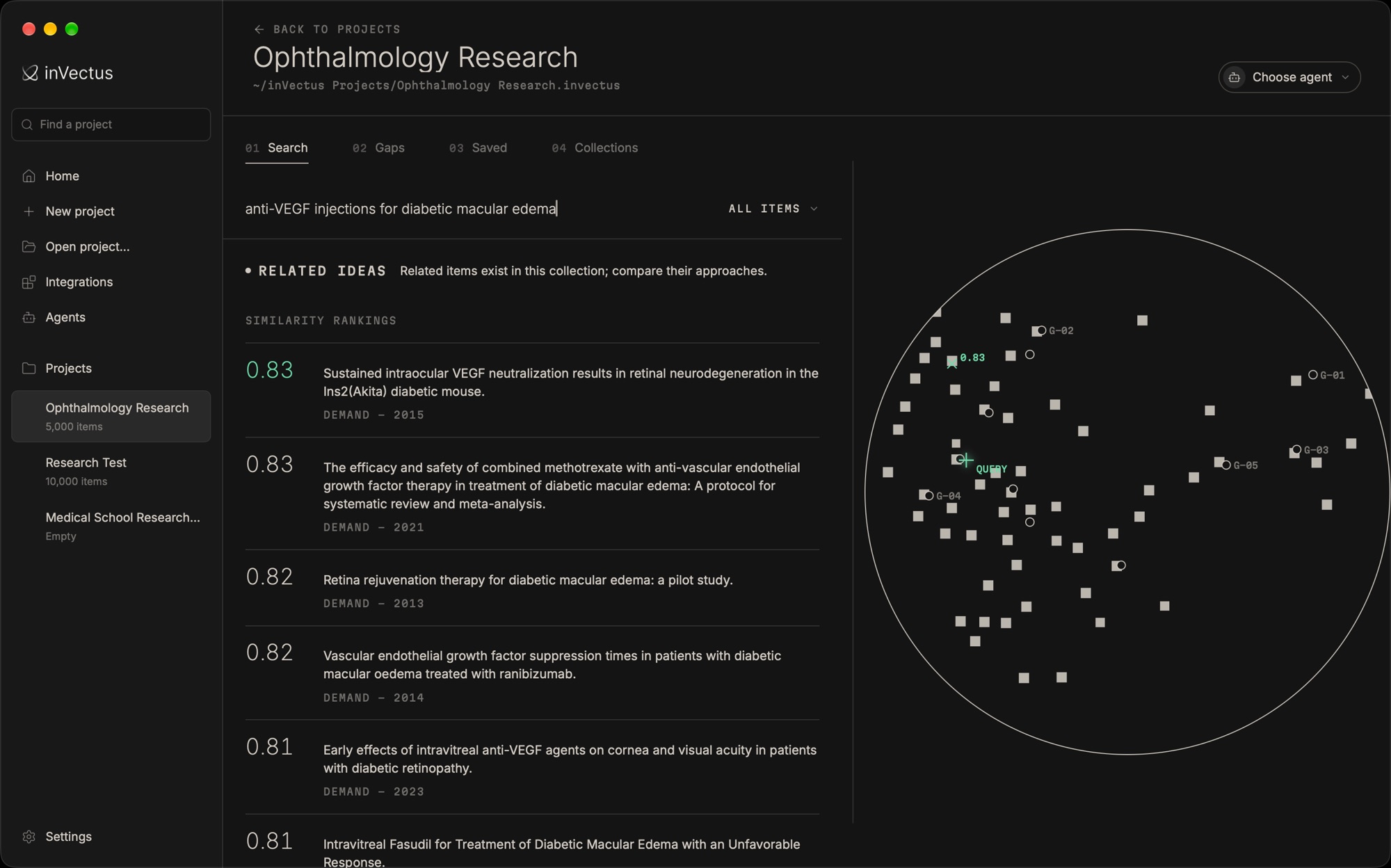
  4. Semantic search with supporting medical-paper matches.
    04Search by meaning. Compare an idea with the collection and inspect the nearest papers.
  5. A source paper and its position in the collection map.
    05Inspect the evidence. Open a source paper and see where it sits on the map.
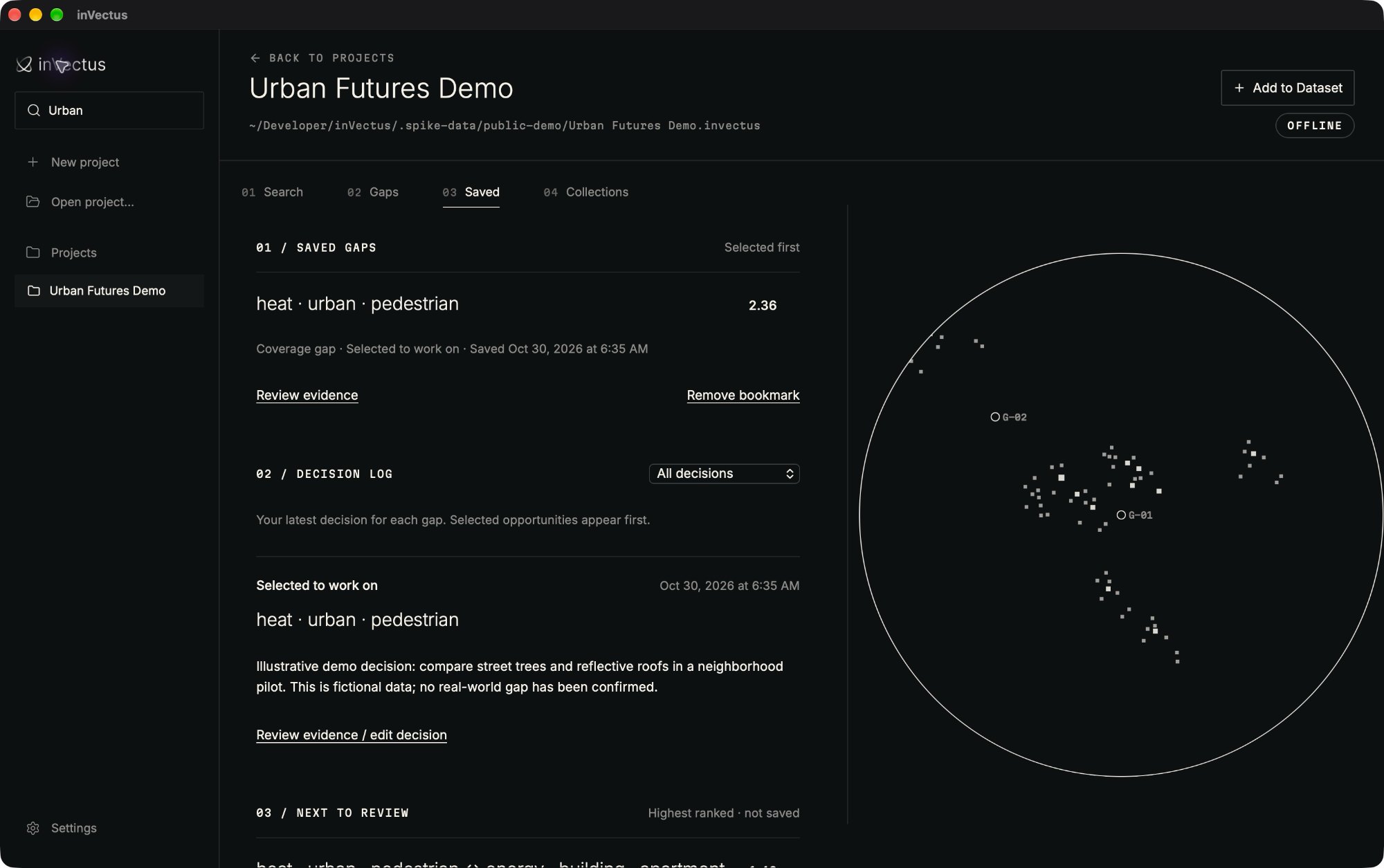
  6. Saved gaps and a human-authored decision in the native app.
    06Keep a decision. Save a gap for review and record what you decided, shown here with a fictional demo collection.
The inVectus website’s Run It on Your Own Computer section, with a star field, Earth’s illuminated horizon, and a rounded footer.
inVectus website · Build-from-source section and footer.

Design & engineering

A responsive research workspace

Typed React screens connect search, imports, evidence, and saved decisions through a Tauri command boundary. A draggable, keyboard-operable split keeps the map beside the evidence and stacks when panes become too narrow. Navigation, map focus, search presentation, and pane sizing have regression tests.

Keep a decision, not just a bookmark

Bookmarks and review decisions have separate records, so saved evidence and notes survive rescans. DuckDB holds metadata; LanceDB holds vectors. The desktop and CLI share Rust crates for local search and resumable, cancellable indexing. Embedding identities prevent comparisons across incompatible vector spaces.

A claim should name its scope

Gap scoring uses the embedding-space graph; the 2D map is for browsing. Incomplete collections, specialist vocabulary, and embedding or clustering artifacts can suggest gaps that do not hold up. Calibration stays visible, evidence stays inspectable, and a person decides what merits investigation. These are collection-scoped candidates, not proof of novelty or scientific value.

Field record · Work and study

Experience

My professional experience is in web design. Alongside paid client work, I independently design, build, and maintain Angrove and inVectus.

The practice

Client work starts with understanding a business and translating its requirements into a responsive layout, then carrying the design through delivery.

My independent projects extend that work into application architecture and applied AI. I use AI coding assistants while owning the interaction decisions, integration, code review, and verification.

Degree
B.S. in Information Science
School
University of South Florida, 2023
Focus
Information Security

Client work

  1. 2024 to now

    PostcardMania

    Web designer

    Design and deliver custom, responsive websites, translating business requirements into individual layouts and managing client-facing delivery deadlines.

  2. 2024

    Cloud Carpenter

    Front-End Web Development Intern

    Designed and built responsive client websites and interactive features with HTML, CSS, JavaScript, and PHP, working with a development team.

Tools, by use

Design

Product design, UI/UX, Figma prototyping, interaction design, design systems, visual design, and responsive interfaces.

Interfaces

React, TypeScript, JavaScript, HTML, CSS, Swift, SwiftUI, and Tauri. Keyboard and responsive interaction work demonstrated in inVectus.

Local software

Rust, Python, DuckDB, LanceDB, SQLite, application architecture, and regression testing. On-device model integration, embeddings, vector similarity, retrieval-augmented generation, and evaluation.

Correspondence

Let’s compare notes.

I’m looking for design engineer roles on AI products, especially at startups in New York and San Francisco. I want a team that values competence over bureaucracy, where moving fast and doing great work aren’t a trade-off. Based in Tampa, happy to relocate.

Ryan and his brother talking on a rooftop overlooking the Tampa skyline at night.

“There's something special about this photo that means a lot to me. This particular conversation with my twin brother is one I think of often, we were in one of my favorite places ever and the memory is burned into me. A friend happened to capture the moment without us realizing.”